
The short answer: dental implants may suit you if you want teeth that stay fixed and feel close to natural, and your jaw and gums are healthy enough for minor surgery. Dentures may suit you if you want a quicker, non-surgical option, or if your jaw needs preparation before an implant. Neither is better for everyone. The right choice depends on your bone, your gums, your health, how many teeth are missing and what you want from the result.
If you are comparing dental implants and dentures in Kondapur, an examination and a scan can show which option is suitable for your teeth, gums and jawbone. The sections below explain the differences so you know what to ask at that visit.
What is the difference between dental implants and dentures?
| Factor | Dental implants | Dentures |
| What it is | A titanium post placed in the jaw, topped with a crown, bridge or denture | A removable set of replacement teeth that rests on the gums |
| Surgery | Yes, a minor surgical procedure is needed | Usually no, apart from any extractions needed first |
| Time | Usually longer, as the jaw needs time to heal around the implant | Usually quicker, though it takes a few visits to get the fit right |
| Feel and stability | Fixed in place and closer to natural teeth | Removable, and may move, especially on the lower jaw |
| Chewing | Often feels firmer and more natural | May feel less firm, and some foods can be harder to manage |
| Jawbone | Helps keep bone in the area where the implant sits | Does not stimulate the bone, so the jaw can keep shrinking over time |
| Daily care | Brush and floss like natural teeth, plus regular check-ups | Remove and clean daily, and handle with care |
| Upfront cost | Generally higher | Generally lower |
| Long term | Fewer adjustments, but needs ongoing gum care | May need relining, adjusting or replacing as the mouth changes |
These are general differences. Your own case may vary, which is why the next sections go through each point.
How do dental implants work?
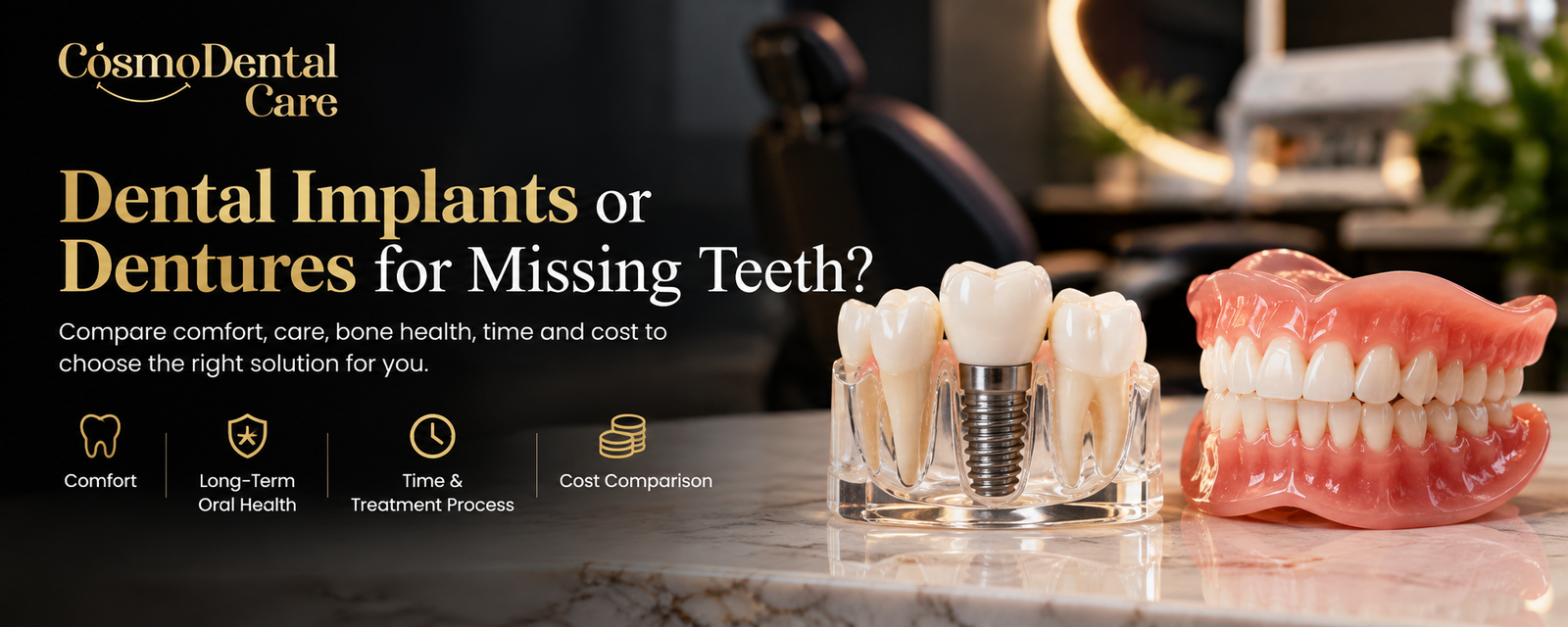
In simple terms, a dental implant replaces the missing tooth root. A small titanium post is placed in the jawbone, and over the following months the bone grows around it and holds it firmly. Once it has healed, a crown, bridge or denture can be attached to it. One missing tooth usually means a single crown. Several missing teeth can be replaced with a few implants supporting a bridge, and a full arch can be held by implants too.
Because the implant sits in the bone, it can feel steady when you eat and speak. It also passes chewing force into the jaw the way a natural root does.
The trade-offs are the surgery, the healing time and the need for good daily cleaning. Gum infection around an implant can damage the bone that holds it, so regular check-ups matter.
How do dentures work?
Dentures are removable replacement teeth. A partial denture fills the gaps when some natural teeth remain. A complete denture replaces all the teeth in the upper or lower jaw. They rest on the gums and, in some cases, are held with adhesive.
They are usually non-surgical and quicker to make, which makes them a practical choice if surgery is not possible or your jaw does not have enough bone for an implant. The trade-off is fit. Dentures can shift when you chew or talk, and because the jaw changes over time, they may need relining, adjusting or replacing.
| Looking at dentures?
Find out how complete dentures are made, fitted and cared for. |
How do implants and dentures affect your jawbone?
When a tooth is lost, the bone that held its root slowly shrinks because it no longer takes the same pressure from chewing. An implant transfers chewing forces to the surrounding bone, which can help maintain the bone around the implant. A denture rests on top of the gum and does not do this, so the bone under it can keep changing.
If you have already lost a lot of bone, an implant may need a bone graft first, or a different plan may suit you better. A scan shows how much bone you have.
Who may be suitable for dental implants?
Implants tend to suit people who have:
- Enough healthy jawbone, or are suitable for a bone graft
- Healthy gums, or gum disease that has been treated
- Stable general health, with conditions such as diabetes under control
- Willingness to keep up with brushing, flossing and regular check-ups
- The time for a longer treatment and a healing period
Smoking and untreated gum disease can slow healing and raise the risk of problems, so your dentist may ask you to address these first. Treating gum problems before an implant is a common part of planning.
Who may be better suited to dentures?
Dentures tend to suit people who:
- Want a non-surgical option
- Need to replace many teeth, or all teeth, in one go
- Cannot have surgery because of their general health
- Do not have enough bone and prefer not to have a graft
- Want a lower upfront cost, or a quicker route to replacing teeth
If teeth are too damaged to keep, they may need to be taken out first. Your dentist can explain how extraction fits into either plan.
Are implant-supported dentures an option?
Yes. An implant-supported denture uses a small number of implants to hold a denture firmly in place, so it moves less than a regular denture. A bridge is another option. It replaces missing teeth using crowns on the neighbouring teeth, though this means those teeth are reshaped. Your dentist can explain which of these fit your situation.
How much do dental implants and dentures cost?
There is no single figure that applies to everyone. Dentures generally cost less upfront. Implants involve more stages, such as scans, surgery, healing and the crown. Over time, dentures may need relining or replacing, so the long-term picture is not always as simple as the upfront one.
For both, the final cost depends on how many teeth you are replacing, the materials, any treatment needed first and the follow-up care. Ask for an itemized estimate and check what it includes.
How do you choose between implants and dentures?
Start with three questions. How healthy are your jaw and gums? How long are you able to wait for treatment? How important is it that your teeth feel fixed in place? Your dentist then weighs your answers against your general health and budget.
Choosing dental implants or dentures in Kondapur
At Cosmo Dental Care in Kondapur, the starting point is an examination. Your dentist looks at your teeth, gums and jaw, goes through your health history, and explains which options may work for you and why.
| Thinking about a dental implant?
Learn how implant treatment works at Cosmo Dental Care in Kondapur, and what a consultation involves. |
Frequently asked questions
Are dental implants better than dentures?
Not always. Implants often feel more stable and natural, but they need surgery, healing time and a suitable jaw. Dentures are non-surgical and quicker, but they can move and may need adjusting. The better option depends on your own case.
Can I get dentures first and implants later?
In some cases, yes. Your dentist can tell you whether this suits your situation and what changes it may need.
Do dentures cause bone loss?
Bone loss can occur after a tooth is lost, regardless of whether you later choose implants or dentures. A denture rests on the gum and does not stimulate the bone the way an implant does, so the bone under it can keep changing.
Is implant surgery painful?
Local anaesthesia is used during implant surgery, so the procedure itself should not be painful. Some soreness, swelling or discomfort can occur afterwards, and your dentist will tell you how to manage it.
What if I do not have enough bone for an implant?
A bone graft may help in some cases. In others, dentures or another option may be a better fit. A scan will show which applies to you.
Do I still need check-ups after getting implants or dentures?
Yes. Regular check-ups help your dentist catch gum problems, check the fit and keep your mouth healthy.
Book a dental consultation in Kondapur
Not sure whether dental implants or dentures are right for you?
Book a consultation at Cosmo Dental Care in Kondapur to have your teeth, gums and jaw assessed and to talk through the tooth-replacement options that may suit you. You can start on the dental implants page.