

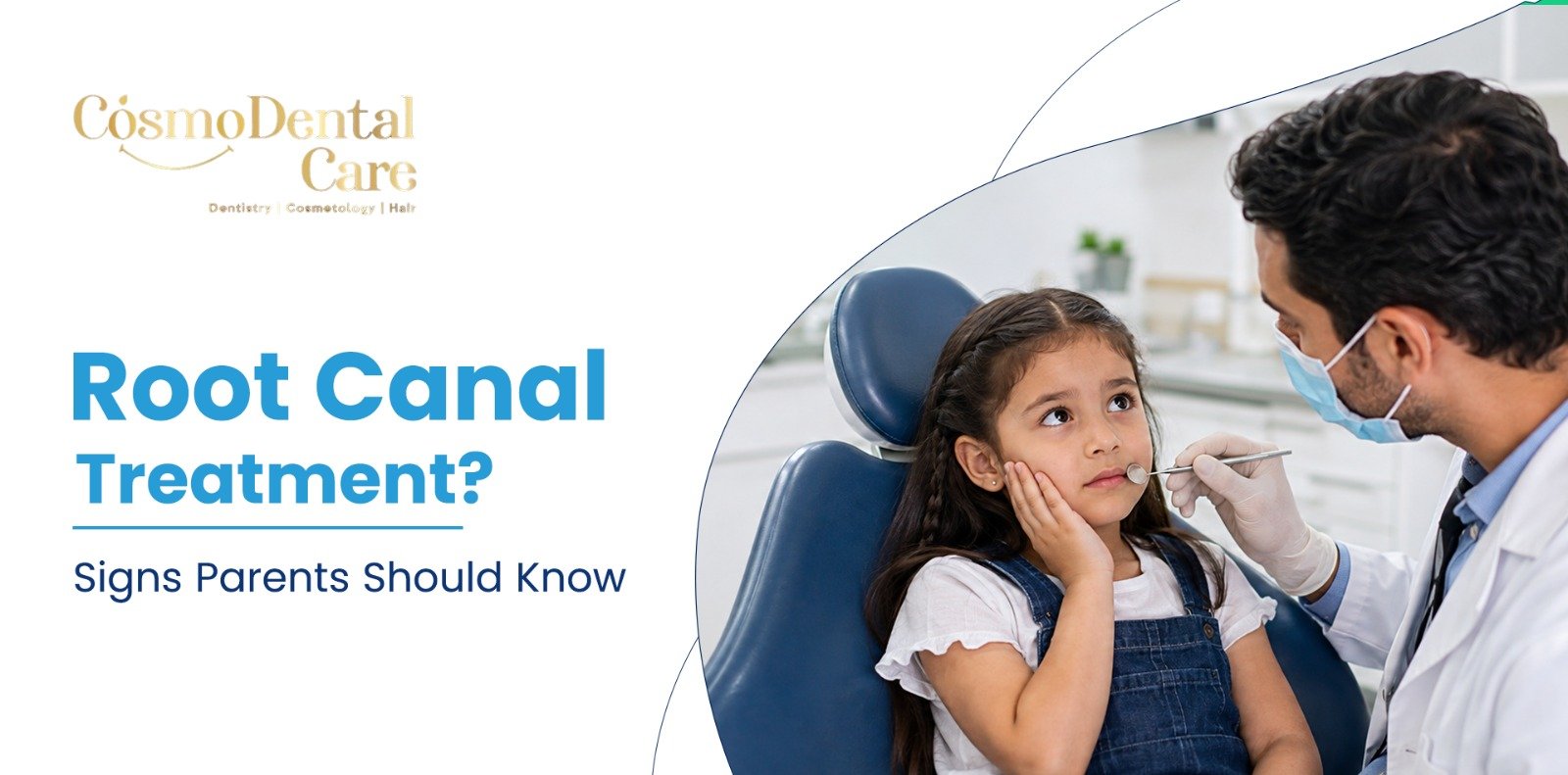
A child may need root canal treatment, often called a pulpotomy or pulpectomy, when decay or injury reaches the pulp, the soft tissue inside the tooth that contains nerves and blood vessels. Common signs include ongoing tooth pain, sensitivity to hot or cold, discoloration of a tooth, swelling in the gums, or pain that wakes your child at night. This kind of pulp therapy is a recognized, well-established approach for treating decay in baby teeth without losing the tooth early. Cosmo Dental Care in Kondapur, Hyderabad, helps parents get a clear diagnosis quickly when a child is in pain.
Your child says a tooth hurts, and your mind immediately jumps to the worst-case scenario. The words “root canal” attached to your child’s baby tooth can feel alarming, especially when you assumed baby teeth did not need this kind of treatment at all. You want to know if this is really necessary, or if it is being overly cautious.
This guide walks you through the actual signs to watch for, how this differs from normal teething discomfort, and what treatment really involves for a child.
What are the signs your child might need root canal treatment?
A few signs tend to show up together when a baby tooth’s pulp is affected by decay or injury. Ongoing tooth pain, especially pain that is not clearly tied to a specific trigger and does not go away quickly, is one of the most common signs. Sensitivity to hot or cold foods that lingers well after the food or drink is gone, rather than fading in a few seconds, is another.
Discoloration of a single tooth, where it looks noticeably darker or grayer than the teeth around it, often points to internal damage or infection inside that tooth. Swelling in the gums near a specific tooth, sometimes with a small bump that looks like a pimple, can signal an abscess forming. Pain that wakes your child up at night, or pain severe enough to affect eating and chewing on one side, are both signs worth taking seriously rather than waiting out.
None of these signs alone confirm that root canal treatment is needed, but if you notice one or more of them together, it is worth having your child examined soon rather than waiting for their next routine checkup.
How can you tell the difference between teething pain and a real infection?
This is one of the most common sources of confusion for parents, since both can involve discomfort, fussiness, and disrupted sleep. Teething and the eruption of new molars typically cause mild, generalized discomfort in the gums, often accompanied by drooling, mild irritability, and slightly swollen gums in the general area where a tooth is coming in. This discomfort tends to come and go and usually responds to simple comfort measures.
Signs pointing toward infection tend to be more specific and more persistent. Pain focused on one particular tooth, rather than a general area, swelling that looks like a distinct bump rather than general gum puffiness, visible discoloration of a single tooth, or pain severe enough to disrupt eating for more than a day or two, all point away from ordinary teething. Fever alongside tooth pain is also a signal that something beyond normal teething may be happening. If you are genuinely unsure which one you are looking at, a quick dental visit is a far more reliable way to know than waiting to see if it resolves on its own.
How do dentists decide whether your child needs a pulpotomy or pulpectomy?
Your dentist will examine your child’s tooth, ask about the pain, and usually take a dental X-ray to see whether the decay has reached the pulp and, if so, how far it has spread. They also check for swelling, tooth mobility, how deep the decay goes, and any visible signs of infection around the tooth.
The goal is not simply to save every baby tooth at any cost. Your dentist first judges whether the tooth is healthy enough to keep. If the tooth can be preserved safely, some form of pulp therapy is usually recommended. If the damage is too extensive, or the tooth is already close to falling out naturally, extraction may turn out to be the better option instead.
This assessment also determines which specific procedure fits the situation. A pulpotomy removes only the affected pulp in the crown, the visible part of the tooth, while leaving the healthy pulp in the roots in place. This is typically used when decay has reached the pulp but has not spread deep into the root canals. A pulpectomy is used when the infection has progressed further, affecting the pulp within the roots as well as the crown. In this case, the dentist removes all of the affected pulp, cleans the canal space inside the roots, and seals the tooth, similar in concept to an adult root canal, though adapted for a smaller primary tooth. Both procedures aim to remove infected tissue, relieve pain, and preserve the tooth so it can continue functioning until it is naturally ready to fall out. Recognized pediatric dental guidelines outline these vital and non-vital pulp therapies as established treatment paths for managing deep decay in primary teeth, rather than treatments dentists reach for as a last resort.
Why is it worth saving a baby tooth instead of just pulling it out?
Many parents assume that since baby teeth eventually fall out anyway, pulling a painful or infected one is the simpler option. In some specific cases, extraction genuinely is the right call, particularly if a tooth is close to naturally falling out or if the damage is too extensive to treat. But in most other cases, saving the tooth matters more than it might seem.
Baby teeth hold space for the permanent teeth developing underneath them. Losing a back baby tooth too early, especially a molar, can allow neighboring teeth to shift into that space, which may crowd or misalign the permanent tooth trying to come in later. Baby teeth also play a direct role in chewing and in a child’s ability to pronounce certain sounds clearly while their speech is still developing. Treating and saving the tooth, when possible, avoids these downstream effects and keeps your child’s bite developing the way it should.
What happens during treatment, and how should you care for your child afterward?
Knowing what actually happens takes a lot of the fear out of the process. Your child’s dentist will first numb the area to keep your child comfortable throughout. The infected or damaged pulp is then removed, either from just the crown for a pulpotomy or from the crown and roots for a pulpectomy, and the space is cleaned and disinfected. A medicated material is placed to protect the remaining healthy tissue and calm the nerve, and the tooth is then sealed and usually finished with a dental crown, often a stainless steel or tooth-colored crown, to protect it going forward.
Most children describe the sensation as similar to getting a filling rather than anything more intense, and the procedure is typically completed in a single visit. Afterward, your child may have some mild soreness or numbness for a few hours as the anesthesia wears off, so softer foods and avoiding very hot or cold items for the rest of that day generally help. Mild discomfort for a day or two is normal, but pain that is severe, gets worse instead of better, or is accompanied by swelling or fever after treatment is worth a follow-up call to your dentist rather than waiting it out.
When is a symptom urgent, and when can it wait for a regular appointment?
Not every sign needs an emergency visit, and knowing the difference helps you respond calmly rather than panicking. Mild, occasional sensitivity, a small amount of discomfort while chewing on one side, or slight discoloration you just noticed can usually wait for the next available regular appointment, ideally within a week or two rather than months away.
Persistent pain that disrupts sleep or eating, visible swelling in the gum or face, or a tooth that has become noticeably darker fairly quickly are signs to call your dentist promptly, generally within a day or so, rather than waiting for a routine slot. If your child has significant facial swelling, a high fever alongside tooth pain, or any difficulty breathing or swallowing, this points toward a more serious spreading infection and needs urgent medical attention right away, either through an emergency dental visit or your nearest emergency room, since infections in children can progress quickly. If pus starts draining from the gum, or your child develops difficulty opening their mouth fully, contact your dentist promptly as well, since these can also indicate a spreading infection that needs prompt attention.
What are the benefits and limitations of pediatric root canal treatment?
Relieves pain quickly. Treating an infected or damaged tooth removes the source of the pain, which usually brings noticeable relief once the procedure is complete and any residual soreness settles.
Preserves space for permanent teeth. Saving the baby tooth instead of extracting it helps prevent the shifting and crowding that can happen when a tooth is lost too early.
Supports normal chewing and speech development. Keeping the tooth functional helps your child eat comfortably and continue developing clear speech sounds without disruption.
Requires your child’s cooperation during the visit. Like any dental procedure, a smoother experience depends partly on how comfortable your child feels in the chair, which is why a gentle, experienced pediatric dentist matters.
Not always the right option. In some cases, particularly when a tooth is close to naturally falling out or damage is too extensive, extraction may be the more sensible choice instead, and your dentist will discuss this with you if it applies.
Follow-up care matters. A treated tooth still needs normal brushing, flossing, and regular checkups, since the surrounding teeth and gums remain just as important to your child’s overall oral health going forward.
Frequently Asked Questions
Q: Can a baby tooth infection spread if untreated? A: Yes, an untreated infection in a baby tooth can spread to surrounding tissue, nearby teeth, or in more serious cases, deeper into the face or jaw. This is part of why signs like swelling, persistent pain, or fever are worth addressing promptly rather than waiting, since catching an infection early generally means a simpler, less invasive treatment.
Q: Does a pediatric root canal hurt more than a filling? A: Most children describe the sensation as similar to getting a filling, since the area is numbed beforehand and the procedure focuses on removing the source of pain rather than causing new discomfort. Some mild soreness once the anesthesia wears off is normal, but the procedure itself is not typically more painful than other common dental treatments.
Q: Will treating a baby tooth affect the permanent tooth underneath? A: When performed correctly, treating and saving a baby tooth generally supports healthy development of the permanent tooth underneath by maintaining the space it needs to come in properly and grow in the right position. Leaving an infection untreated is actually more likely to cause problems for the permanent tooth than the treatment itself, since untreated infection can spread toward the developing tooth below.
Q: How do I know if my child’s tooth pain is serious? A: Pain that is persistent, disrupts sleep or eating, or comes with swelling, discoloration, or fever points toward something more serious than everyday sensitivity. Mild, occasional discomfort that fades quickly is usually less urgent, but if you are ever unsure, a prompt dental visit is the most reliable way to find out rather than waiting to see if it gets worse.
Q: Can a child be sedated for root canal treatment? A: In many cases, local anesthesia alone is enough to keep a child comfortable during a pulpotomy or pulpectomy, similar to a filling. For younger children, those who feel especially anxious, or more involved cases, a pediatric dentist may discuss mild sedation options with you beforehand, tailored to your child’s specific needs and comfort level.
Q: Can my child eat after a pulpotomy? A: Yes, once the numbness wears off, your child can usually eat soft foods without any issue. It is best to avoid very hard, sticky, or extremely hot foods on the treated side for the rest of that day, unless your dentist gives you different instructions based on your child’s specific case.
Where can you get your child’s tooth pain checked in Kondapur?
Tooth pain in a child is stressful to watch, and getting an accurate diagnosis quickly matters more than guessing at home. Cosmo Dental Care in Kondapur, Hyderabad, offers gentle, experienced pediatric dental care, so you get a clear picture of what is happening and what treatment, if any, your child actually needs. Keeping up with regular oral prophylaxis and scaling also helps catch decay early, often before it progresses far enough to need pulp treatment at all.